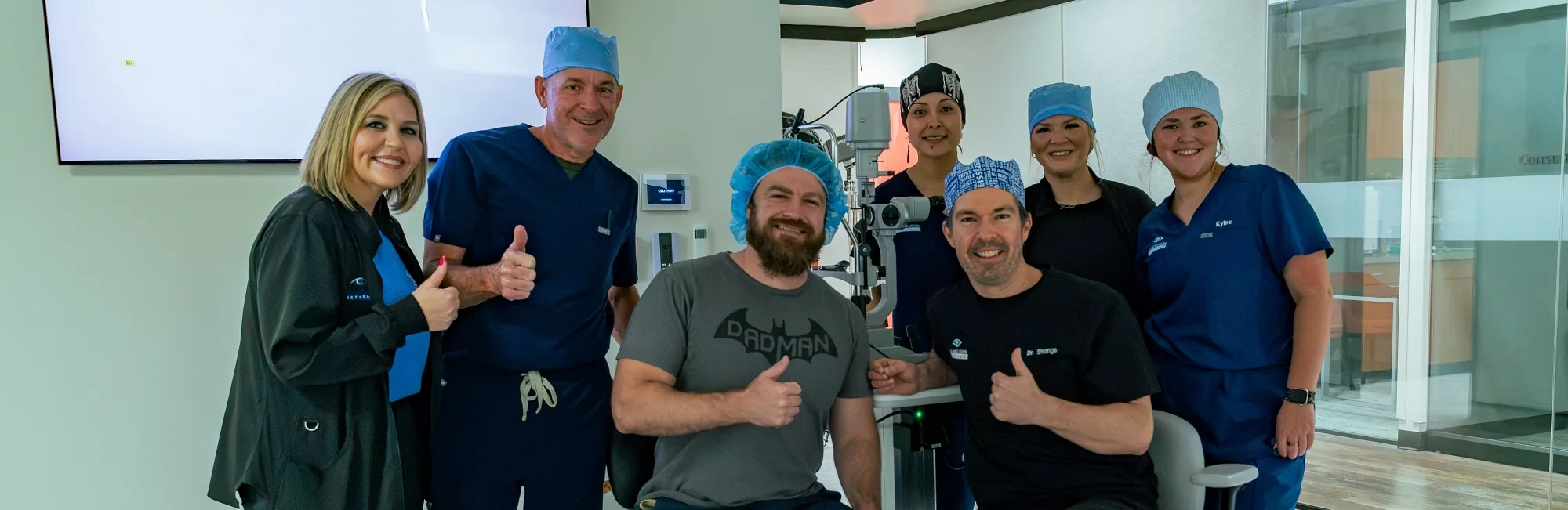

Navy SEAL Veteran Briggs
Navy SEAL Veteran Briggs
Briggs spent 14 years in the SEAL teams. His vision was never a small detail in that work. It was equipment.
For years he was told his eyes were not a candidate for laser vision correction. He had accepted that glasses were permanent. Then he met Dr. Taylor Strange, DO, founder of Alliance Vision Institute. One week after his LASIK procedure, Briggs had not reached for his glasses once.
“My name is Briggs. I spent 14 years in the SEAL teams,” he says. “Here in Texas, America, true American now. And I’m just grateful for the opportunity that Dr. Strange has given me.”
Most people who wear glasses deal with inconvenience. Briggs dealt with risk.
“It impacts my shooting,” he says. “Having glasses and trying to shoot, if you lose your glasses, you can’t get them back right then. You’re kind of in a tough spot.”
That is not a hypothetical for someone who shoots professionally. It is a live problem on every range day and every training cycle. For Briggs, clear vision ties directly to how he works. “This is how I protect and provide for my family,” he says. “I take that very seriously.”
Briggs had looked into vision correction before he came to Alliance Vision Institute. The answer he kept getting was no.
“I met with some other providers, and I think mainly due to the technology difference, they were unable to do the procedure I needed,” he says.
So he made peace with it. “I didn’t think it would be possible to do LASIK,” he says. “I just thought I was going to have to go many more years dealing with it. So I just thought I was going to have to deal with it, or do a lens replacement one day.”
This is a common story at AVI. A practice can only offer what its diagnostic and laser platforms support. Older equipment cannot treat every prescription or every corneal profile. LASIK at Alliance Vision Institute is performed on the WaveLight Contoura Vision system, a topography-guided platform, with wavefront analysis and corneal imaging behind every treatment plan. Dr. Strange also performs PRK, EVO ICL, and refractive lens exchange, so the recommendation follows the eye rather than the equipment.
For Briggs, the answer was yes.
“But Dr. Strange has all the latest technology for eye surgeries, and he was actually able to do it,” he says. “But Dr. Strange was able to do this and fix all of that.”
Briggs came in on a referral, and the referrals said two things.
“Dr. Strange has been spoken highly of by many people, and his reputation, not only of being good at what he does, but he’s just kind, and he cares,” he says.
That combination is what settled it for him.
“Sometimes you get one or the other,” Briggs says. “There’s kind people who are bad at what they do, and people good at what they do who are ruthless. But he’s kind and good at what he does. And that gives me the confidence to move forward with gratitude.”
He credits the connection itself. “Honestly, I think it’s been a blessing from the Lord that he connected me with Dr. Strange,” he says. “Someone who’s not only kind, but good at what they do.”
Before surgery, Briggs was asked what he was looking forward to seeing clearly.
“My wife, my daughter, and baby to come, and those I care about,” he says. “And the targets down range.”
Briggs came back for his follow-up a week after the procedure. He had not worn glasses since.
“The experience was great. Everyone was kind, professional, and helpful,” he says. “And the technology is pretty amazing, to be able to recover as quickly as you can after fixing your vision through that procedure.”
“In the week that’s passed, I haven’t had to wear glasses,” he says.
Near vision was the surprise. “I know distance vision takes a little bit to kick in again, but I haven’t been able to see close-up in years,” he says. “This has all been blurry. So it’s crazy that it improves that quickly.”
The part that landed hardest was not the range. It was his family. “Being able to see my wife and daughter, and those I love, without having to wear glasses has been pretty amazing,” he says. “And just being able to get through the day without having to have those on hand.”
The work benefit came next. “I look forward to getting into some of the work that I do, out onto the range and stuff, and not having to lug those around,” he says.
A fast recovery is characteristic of LASIK. The procedure takes roughly 15 minutes per eye, and most patients see clearly within 24 hours. Vision continues to sharpen over the following weeks, which is the settling period Briggs describes.
Asked what he would remember, Briggs did not name the technology first. He named the people.
“I think the detail that stood out to me most has been Dr. Strange’s kindness, and the kindness of his team,” he says. “They know what they’re doing, but there are a lot of people who know what they’re doing and are not necessarily kind during the process. Dr. Strange and his whole team are extremely kind and helpful.”
He also noticed how invested Dr. Strange is in the technology itself. “Dr. Strange, I really do think he cares. I don’t think it’s just a numbers game,” Briggs says. “He also nerds out over the technology too, which is helpful.”
“A lot of other people are using old equipment where they can’t even do procedures on certain people’s eyes, but Dr. Strange has all the latest technology and is able to cover whatever’s possible today,” he says. “So it’s been phenomenal.”
Briggs waited years, mostly because he had been told there was nothing available for his eyes. His advice to anyone still waiting is direct.
“To someone who’s been putting this off, I just say there’s no reason,” he says. “With today’s technology, it’s a pretty phenomenal procedure. I don’t think there’s a reason not to go through it.”
“Recovery is amazingly short for what it’s doing,” he says. “I’d absolutely recommend Alliance Vision over anyone else.”
“I’m just super grateful,” Briggs says. “It’s just a blessing from the Lord the way all this came about, and just being able to connect with Dr. Strange.”
Briggs was told no by other providers before he was told yes. If that sounds familiar, the reason is often the equipment rather than your eyes.
Custom bladeless LASIK corrects nearsightedness, farsightedness, and astigmatism. When LASIK is not the right fit, there are four other paths, including PRK and EVO ICL for thin corneas and higher prescriptions. A full exam is the only way to know which one belongs to your eyes.
Alliance Vision Institute offers all six major vision correction procedures across four DFW locations: Fort Worth, Southlake, Northlake, and Decatur. Dr. Strange and the AVI surgical team have performed more than 30,000 vision correction procedures.
Thank you, Briggs, for trusting Dr. Taylor Strange and Alliance Vision Institute with your vision, and for sharing your story so openly. Fourteen years in the SEAL teams is a debt the rest of us do not get to repay. Helping you see your wife, your daughter, and the targets down range clearly is a privilege.
Not always. A no often reflects the diagnostic and laser technology available at that practice, not a permanent fact about your eyes. Prescription strength, corneal thickness, and corneal shape all factor in. Briggs was told no more than once before Dr. Strange was able to treat him. If LASIK truly is not right for your eyes, PRK, EVO ICL, and refractive lens exchange cover most of the remaining ground.
Most LASIK patients see clearly within 24 hours and return to normal activity quickly. Strenuous activity, swimming, and dusty environments wait longer, and your surgeon sets that timeline at your follow-up visits. Briggs was glasses-free through his first week after surgery.
It is a common reason patients come in. Removing glasses from a range day or a training cycle removes a failure point. Candidacy still depends on your measurements, your eye health, and the demands of your specific work, which is what the consultation is for.